 National Center for High-performance Computing
Backbone Fiber-optic Network
In terms of the vertical backbone design, fiber-optic cables are laid along the cable troughs on both the eastern and western sides of the Taiwan High Speed Rail (THSR) tracks to ensure high availability and security. Concurrently, lateral extension cables are planned to connect 19 critical nodes—including north and south submarine cable landing stations, two network exchange centers, four science parks, five major academic research network hubs, and various universities. By extending terrestrial fiber-optic cables to connect submarine cable landing stations and exchange centers, a high-speed network exchange hub is established, further facilitating international data flow and scientific research applications.
Along the THSR line, 13 relay equipment rooms and 16 drop points have been established, with 1 to 2 drop points reserved along key road segments in each county and city for convenient user fiber-optic access. The relay equipment rooms are evenly spaced and equipped with rack space along with stable, ample power to support users' relay transmission equipment. Additionally, these facilities feature a hot/cold aisle layout and highly efficient, energy-saving environmental conditioning modes, fulfilling the requirements for green data centers.
The fiber-optic monitoring system is monitored 24/7 by NCHC personnel to guarantee communication quality. In the event of a fault, real-time alerts are triggered and integrated with a GIS mapping system for precise location tracking, thereby shortening response and repair times. Monitoring for the relay equipment rooms consolidates HVAC, fire protection, ambient temperature, power, and access control systems into a single information platform, enabling operators to remotely verify normal facility operations at any time.
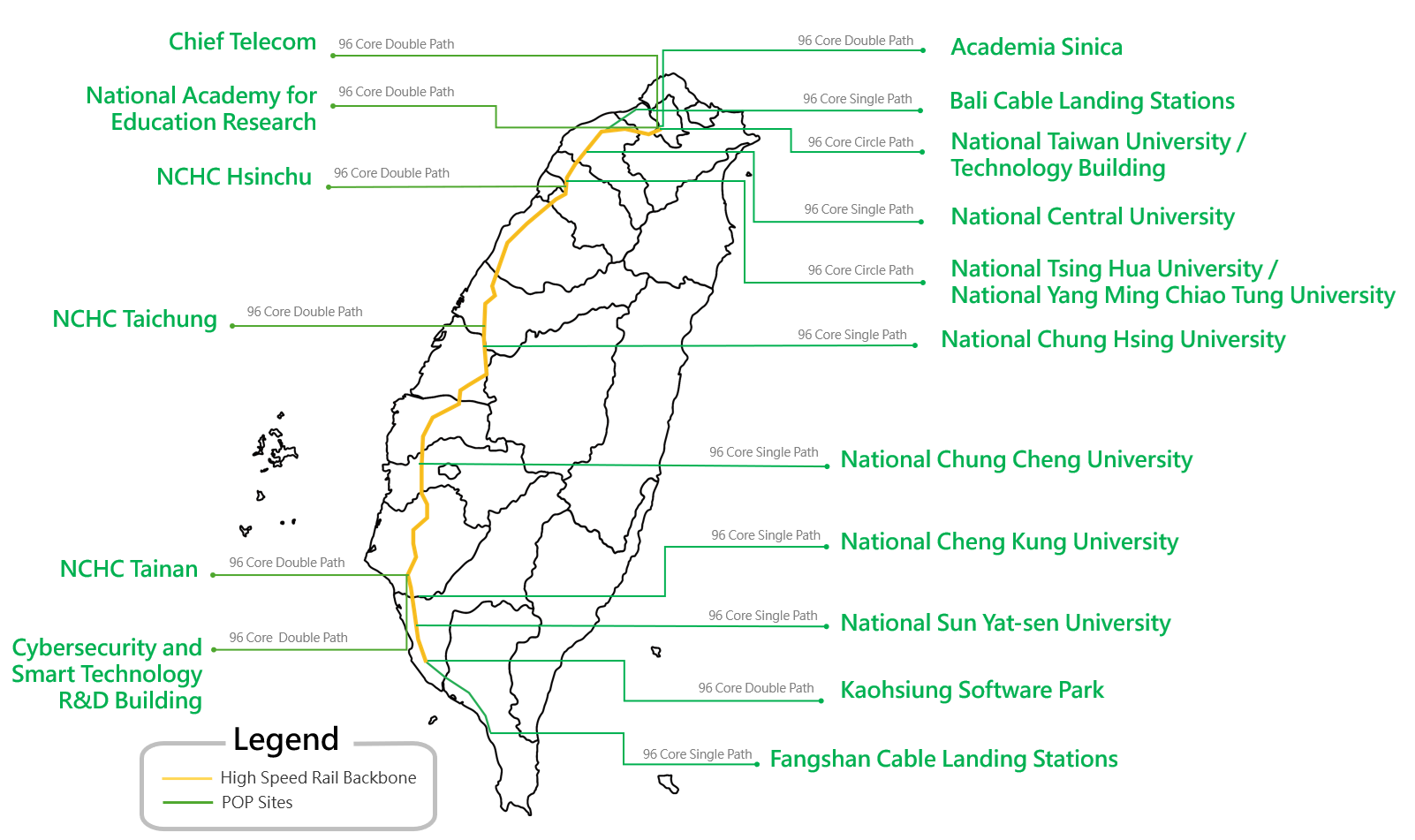
NCHC backbone fiber-optic network