 國家高速網路與計算中心
Integrating Generative AI with Pig Behavior Monitoring: ATARI Drives the Transformation of Smart Livestock Farming
As labor shortages persist and farm operations continue to scale up, traditional manual inspection methods are becoming increasingly inadequate for modern livestock management. To help farmers gain better, smarter oversight of breeding conditions, the Ministry of Agriculture has supported the Agricultural Technology Research Institute (ATARI) in collaborating with the National Center for High-performance Computing (NCHC), under the National Institutes of Applied Research (NIAR), to jointly develop the "Pig Q&A AI" system.
By integrating generative AI language models with computer vision technologies, the system provides an interactive platform that enables real-time queries on pig behavior and health anomalies.
Leveraging NCHC Computing Power to Enable Intelligent Livestock Data Management
In recent years, ATARI has actively promoted digital transformation in smart agriculture by deploying cameras and environmental sensing devices in pig farms to collect data such as temperature, humidity, ammonia concentration, and animal activity levels.
According to Section Chief Yu-Ting Hung, these data were previously presented mainly through dashboards, which were often difficult for farmers to interpret. To lower the barrier to use, the team adopted generative AI to develop a LINE-based conversational query interface, allowing farmers to ask questions in natural language, such as "Which pen had lower feed intake yesterday?" or "Is the temperature in the barn too high today?" The system automatically retrieves backend data and generates intuitive responses, making data utilization more accessible and practical.
During development, the team faced two major challenges. The first was the accurate interpretation of specialized livestock terminology—such as "weaning rate" and "growth performance rate"—which are often poorly understood by general-purpose language models. The second challenge involved ensuring data security and privacy for farm operations.
Assistant Researcher Kuo-Wei Lee explained that by leveraging NCHC's TAIWAN AI RAP high-performance generative AI application development platform, the team was able to integrate large language models with private datasets while incorporating domain-specific terminology. This approach enables accurate AI-generated responses without compromising data confidentiality. In addition, the team adopted NCHC-provided Taiwanese-language speech models, allowing farmers to interact with the AI using local dialects, better aligning with on-site usage habits.
The "Pig Q&A AI" system has already been deployed at ATARI's self-operated experimental pig farm, which is equipped with comprehensive meteorological sensors and imaging-based monitoring systems. With real-time collection and analysis of pig behavior data, farm staff can now receive immediate alerts for abnormalities along with health recommendations.
After implementation, daily workload has been reduced by nearly one hour per person, while weaning and growth performance rates have improved by approximately 3% to 5%. ATARI noted that the system enables on-site managers to more quickly identify key barns and potential risks, significantly enhancing operational efficiency and animal welfare.
The system architecture of "Pig Q&A AI" also demonstrates strong potential for future expansion. Depending on demand, it can be extended to other agricultural domains, enabling farmers to query information on crop cultivation, disease prevention, and more through natural language interactions.
With NCHC's computing resources and AI platform services, agricultural technology in Taiwan is steadily advancing from sensing to understanding, and from data to intelligence—driving more efficient and sustainable agricultural management.
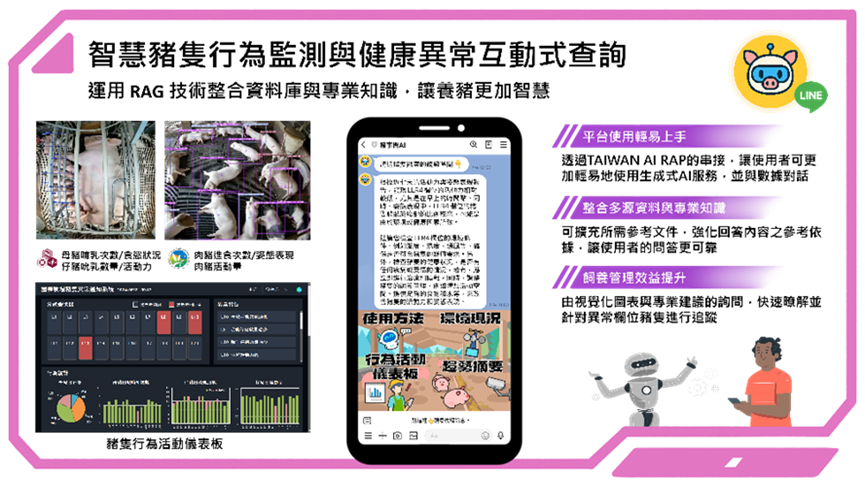
Service Overview of "PigSense AI"
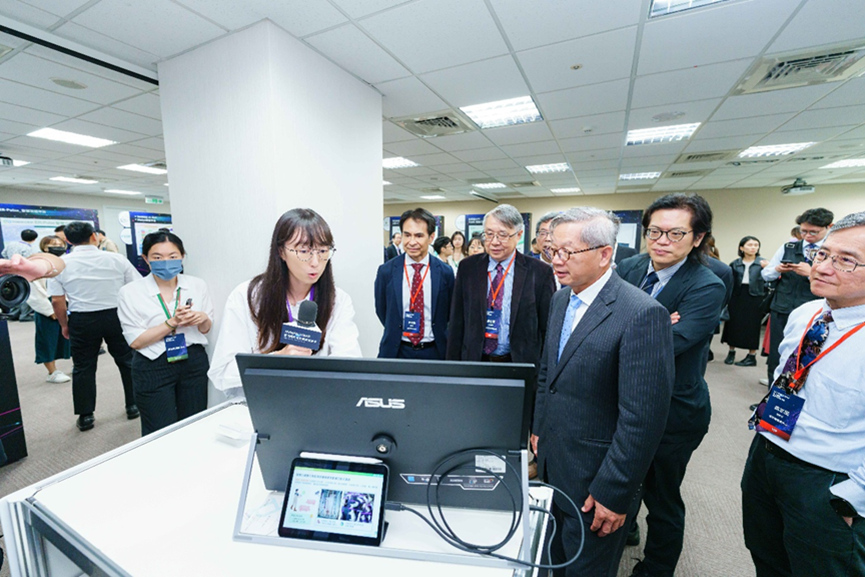
Ms. Hung Yu-Ting, Section Chief, presenting and explaining the system to Minister Wu Cheng-Wen at the TAIWAN AI RAP x TAIDE Showcase
