 國家高速網路與計算中心
Precision Police Governance: Taichung CIC and NCHC Pioneer AI-Driven Image Geolocation for Real-Time Anti-Disinformation
Leveraging the power of technology to enhance digital governance has become a strategic priority for modern governments. The Criminal Investigation Corps of the Taichung City Police Department (Taichung CIC), in strategic partnership with the National Center for High-performance Computing (NCHC), has developed the "Intelligent Cloud-based Recognition System." By harnessing cutting-edge AI, the system enables law enforcement to rapidly identify and geolocate the precise origins of social media videos. This capability significantly streamlines the verification of misinformation, effectively mitigating the societal disruption caused by fabricated content.
In an era where short-form videos and "fake news" proliferate across social platforms, maintaining social stability has become increasingly complex. Traditionally, investigating such incidents involved a cumbersome hierarchical process: frontline officers received alerts, conducted manual on-site verifications, and channeled reports back through administrative layers—a workflow that typically consumed one to two hours. Furthermore, variations in officers' local geographical knowledge often created bottlenecks in investigative efficiency.
To overcome these hurdles, the newly developed system facilitates "sub-second" image search and geolocation directly from video frames, realizing a sophisticated "Image-to-Ground" forensic paradigm.
The system's evolution is categorized into two pivotal phases:
- Phase I: Scene Text Recognition (STR): Utilizing Optical Character Recognition (OCR) to extract high-salience information from environmental cues—such as multilingual signage and storefront branding—to achieve precise spatial localization.
- Phase II: Background Feature Matching: Advancing beyond text-dependency, this phase employs deep learning models to analyze relatively static urban background features, emulating human cognitive processes for scene understanding. To support this, a localized repository of approximately 530,000 geo-tagged street-view images of Taichung has been established, each enriched with precise timestamps and coordinates.
In terms of performance, keyword-based searches yield results within one second, while complex image-to-street-view matching is completed in approximately three seconds. Since its deployment in May 2024, the system has successfully facilitated the prosecution of high-profile disinformation cases. Beyond forensics, the system offers value-added geospatial insights; by analyzing the distribution of specific keywords, police can identify and visualize emerging public security hotspots from a novel perspective.
In this initiative, NCHC provided not only the supercomputing power and high-speed network infrastructure but also the R&D expertise to overcome two critical technical barriers:
- Robust STR in Complex Scenarios: Developing models capable of decyphering the diverse typography of Taiwanese signage under challenging lighting and varying orientations.
- Beyond Landmark Recognition: Shifting the model's focus from transient foreground objects to persistent background geometry, enabling accurate identification in non-landmark locations like residential alleys.
This collaboration exemplifies a successful Public-Research Partnership (PRP) and underscores NCHC's prowess in AI computer vision. Looking ahead, Taichung CIC plans to scale the system to all units city-wide. To accommodate concurrent access by thousands of officers, the team is deploying a distributed, containerized architecture (e.g., Kubernetes-based) and conducting rigorous load testing. The roadmap includes refining text-independent recognition and, subject to funding, integrating Large Language Models (LLMs) and AI Agents to create a data-driven, autonomous decision-making framework, setting a new benchmark for digital policing.
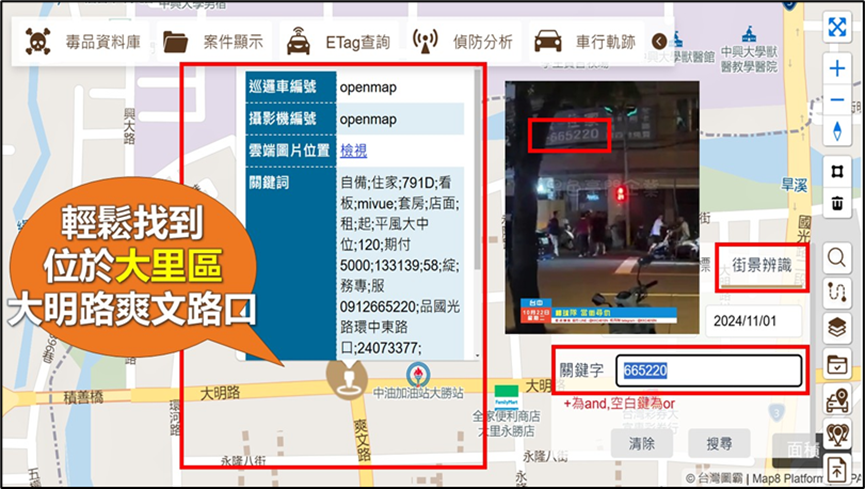
Case study: Successful geolocation via keyword-based street-scene recognition.
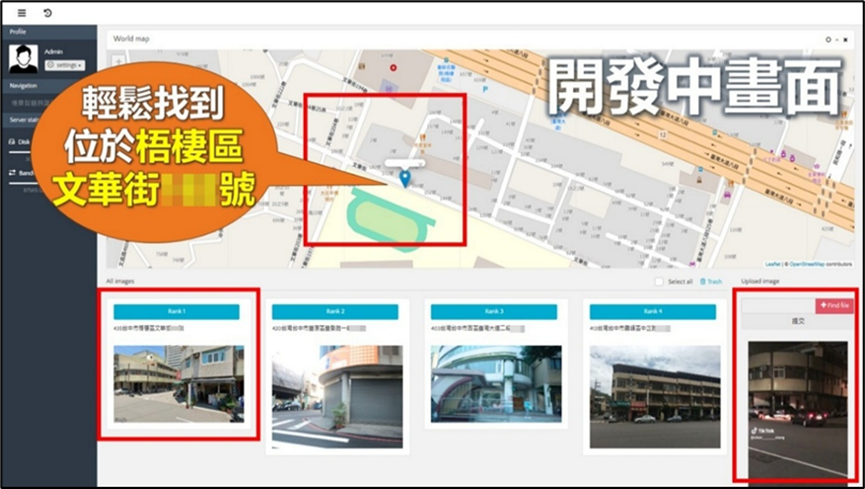
Advanced forensic application: Identifying crime scenes using background feature matching (under development).
%E4%B9%8B%E5%AF%A6%E9%9A%9B%E6%A1%88%E4%BE%8B.png)