 國家高速網路與計算中心
Kaohsiung Veterans General Hospital Partners with NCHC to Enhance Emergency Department Handover Efficiency with Generative AI
In response to challenges posed by healthcare workforce shortages and an aging population, Kaohsiung Veterans General Hospital (KSVGH) has partnered with the National Center for High-performance Computing (NCHC) under the National Institutes of Applied Research (NIAR) to develop the ER-Pulse Smart Handover Platform, leveraging generative AI to improve emergency department (ED) handover efficiency and enhance clinical safety.
The platform integrates data from emergency medical record systems (EMR/EHR) and automatically extracts key patient information—including demographics, vital signs, laboratory and imaging reports, medication records, and consultation notes—to generate concise handover summaries within 2–5 seconds, replacing the traditional manual process that typically required 5–10 minutes per patient.
Dr. Po-Hsiang Lin, attending physician in the Department of Emergency Medicine at KSVGH, noted that ED data are highly heterogeneous, encompassing multimodal formats such as text, images, and numerical values. Under conventional workflows, physicians must manually cross-check laboratory results and imaging records, a process prone to error under time pressure. By adopting NCHC's Resilient and high-performance AI platform (AI RAP) for high-performance generative AI development, the medical team can directly access multiple large language models (LLMs) via the cloud to rapidly generate clinical summaries and risk alerts.
The platform also provides a Prompt Management Interface and an intuitive user interface, enabling physicians to fine-tune generated content according to clinical workflows and professional terminology, ensuring that handover records align closely with real-world medical practice.
TAIDE Local Language Models Accelerate AI Deployment at KSVGH
NCHC's high-performance GPU computing resources and pretrained models have significantly reduced the cost and complexity of deploying AI systems at the hospital. Physicians noted that building equivalent in-house computing infrastructure would require six months to one year before becoming operational. In contrast, by leveraging NCHC's platform, a dedicated hospital model can be activated within one week after submitting an application.
In addition, the TAIDE language model, trained on Taiwan-specific datasets, is capable of understanding local medical contexts and Chinese clinical terminology, improving both the accuracy and readability of generated content while ensuring compliance with domestic regulatory requirements.
Following the implementation of the ER-Pulse Smart Handover Platform, the average handover time per patient has been reduced to under one minute, representing an overall efficiency improvement of more than 60-fold. The time saved allows physicians to focus more on clinical decision-making and patient communication, indirectly improving the quality of care. The AI system can also automatically generate patient education materials and warning indicators, helping to reduce revisit rates and further enhance medical safety.
Beyond clinical operations, the platform has also become a valuable tool for medical education. Resident physicians can review AI-generated handover summaries alongside clinical recommendations to quickly grasp key patient conditions and decision-making logic, supporting training and feedback processes.
KSVGH emphasized that AI is not intended to replace physicians, but rather to serve as a collaborative partner and an extension of clinical knowledge. NCHC's TAIDE models and AI RAP platform have become critical enablers for the real-world adoption of smart healthcare solutions, providing not only stable computing power but also transforming local medical data into actionable intelligence—positioning AI as a core engine driving clinical digital transformation.
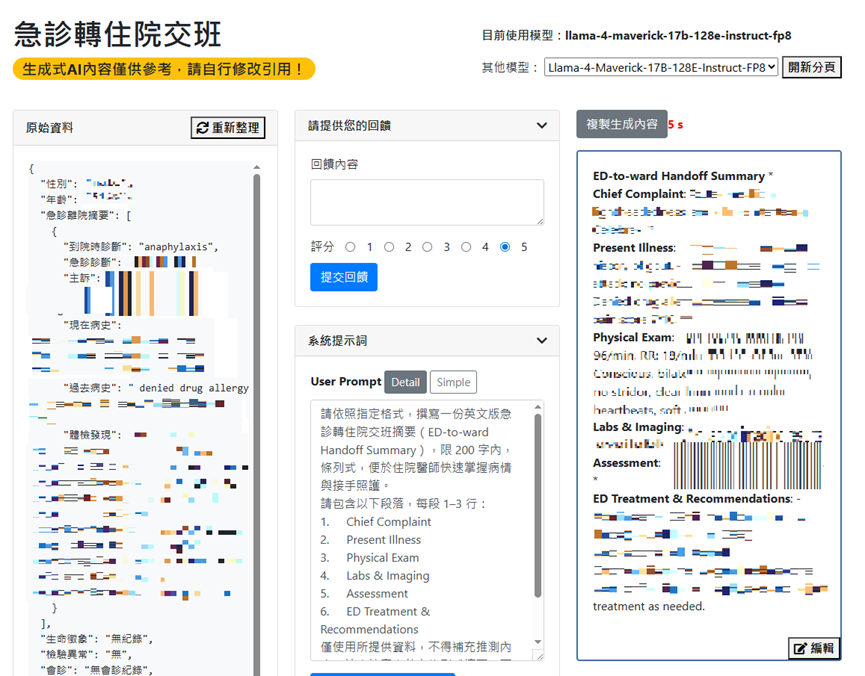
The ER-Pulse Smart Handover Platform at Kaohsiung Veterans General Hospital enhances emergency department handover efficiency and clinical safety through generative AI.
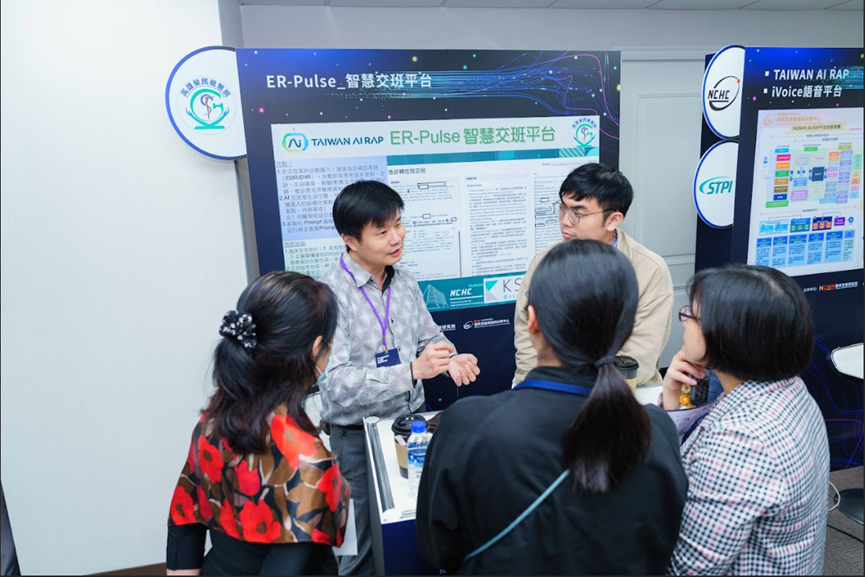
Dr. Po-Hsiang Lin, attending physician in the Department of Emergency Medicine at Kaohsiung Veterans General Hospital, shares insights on the ER-Pulse Smart Handover Platform.
