 國家高速網路與計算中心
the Cloud-native Geospatial Development Platform: Create Digital Twins with Multiple Applications
CONTRIBUTING TEAM: I-Liang Shih, Ming-Lung Li, Jo-Yu Chang, Kuen-Long Tsai
The cloud-native geospatial information platform of digital twins can be presented intuitively and in detail, which is considerably helpful for understanding the information in digital governance and supporting decision-making. For example, policy planners and implementers in areas such as urban planning, traffic congestion, and environmental monitoring can use this to keep tabs on the operational status of relevant scenarios in advance and strengthen their ability to respond to emergencies.
The government has continued to strengthen its digital governance capabilities in recent years. But the demand for computing power for three-dimensional spatial digital platforms is very high, and the cost for each organization to build is too high. Therefore, NCHC is creating a co-built platform, which can not only reduce the cost of each organization to build its own graph table, but also enhance the value of the information through the integration and sharing of the platform. At the same time, it can also adapt to different scenarios to develop a number of application systems.
To satisfy the development needs of different fields, NCHC has also developed a series of sharing tools (Widgets) and continuously optimized and expanded them to include functions such as basemap self-swapping and timeline, so that the data display of the graph table is smoother and more interactive.
The three-dimensional geospatial information is used for multiple applications, each of which has different requirements, so we gather internal experts in many fields such as geospatial information, fluid mechanics, and visual computing teams to combine simulated geospatial physical phenomena and visual display on the platform with the goal to make the digital twins more intuitive and vivid. In 2023, NCHC has collaborated with Penghu Port Authority, the Cultural Resources Bureau of the Ministry of Culture, and the Taichung City Government and the Taichung City Fire Department.
The collaboration with the Penghu County Government is to use three-dimensional technology to present the dynamic information of ships entering and exiting the port, and to combine with CCTV images to intelligently manage the entry and exit of ships of all sizes in order to improve the efficiency of port management. It is also a great honor that the successful case of Penghu County Digital Harbor won the 2024 Smart City Innovation Application Award.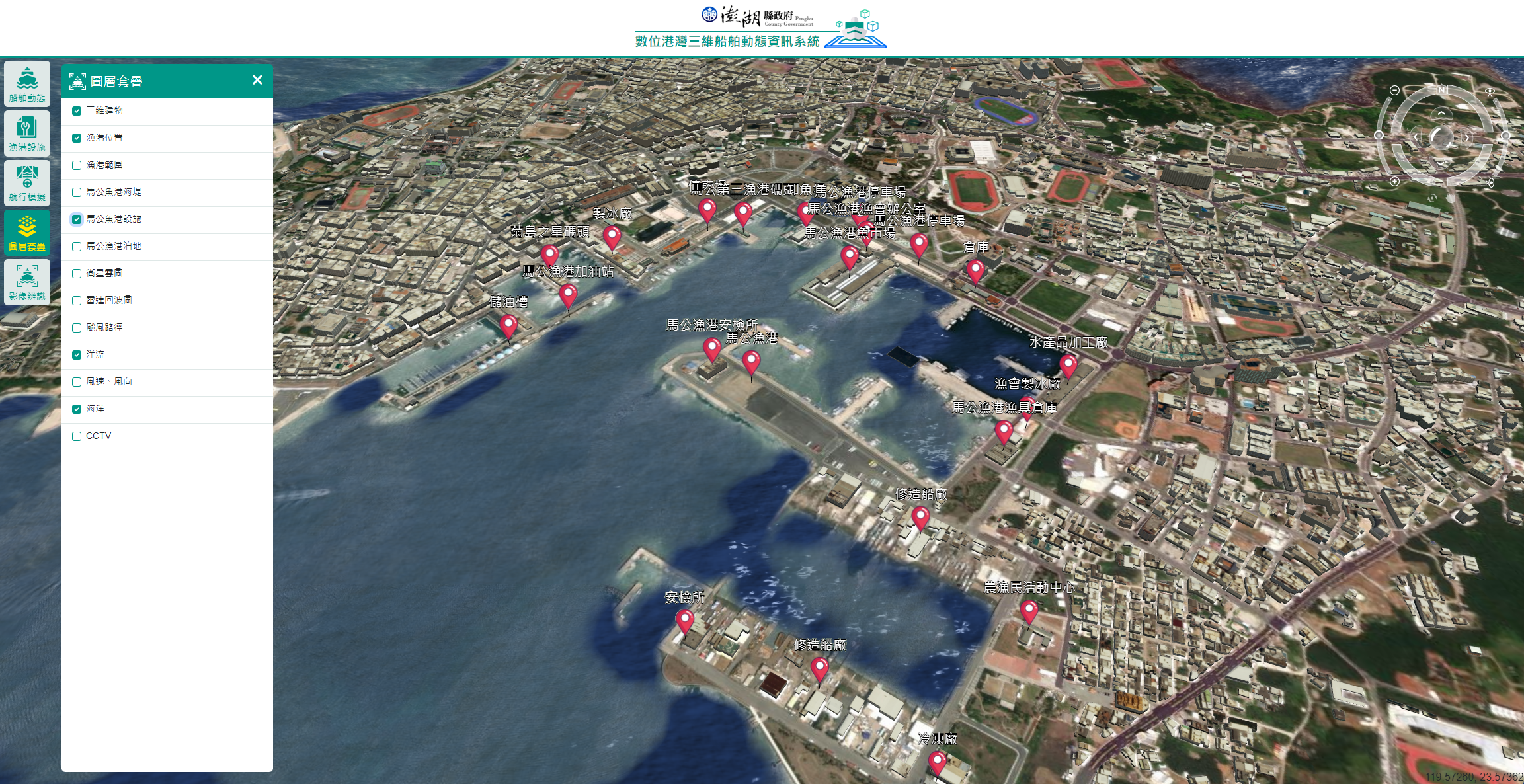
Penghu Digital Harbor 3D environment construction
The Cultural Resources Bureau of the Ministry of Culture applies three-dimensional technology to the monitoring and restoration imagery of Longshan Temple's cultural heritage. We combine the information of environmental factors, such as temperature, humidity, wind direction, and wind speed with the degree of damage to the ancient monuments. Managers can visualize the temperature and humidity of each location in the temple.In addition to space, this system has also incorporated the time factors. Temperature and humidity will be affected by sunlight and space, so it is necessary to observe the numerical changes through the passage of time to restore the monuments to their previous state.
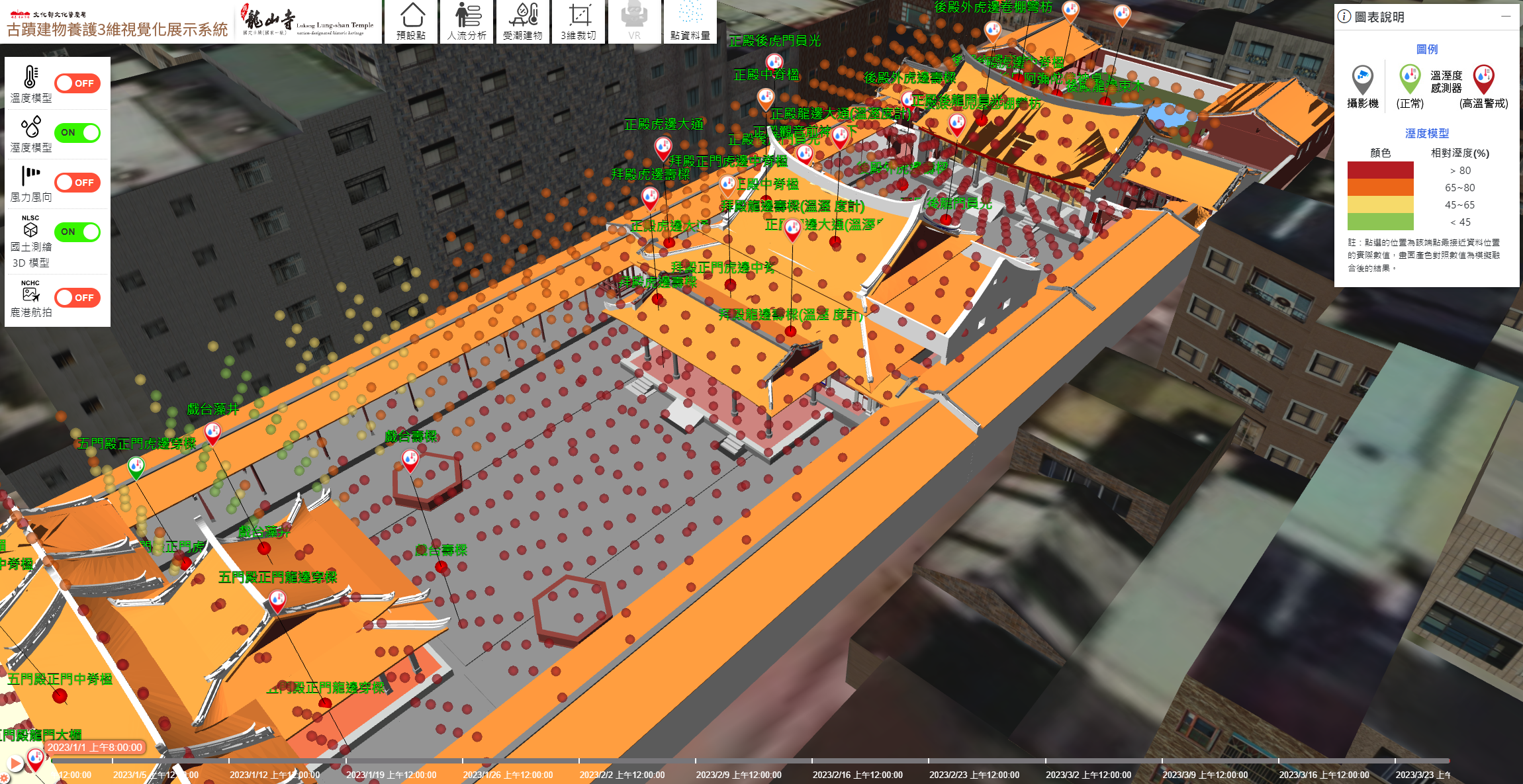
A 3D model of an ancient monument, which can be seen from various angles to see the temperature and humidity changes inside the monument
In the case of Taichung City Fire Department, NCHC create a 3D platform to showcase the all-encompassing view of the search and rescue dog center. Through a 360-degree video presentation, the public can clearly see the kennel, training grounds, dog accommodation, and sports grounds. At the same time, they can also see the actions and training scenes such as crossing culverts or crawling forward from the perspective of search and rescue dogs. In so doing, people learn and understand the hard work in the training process and disaster relief work of search and rescue dogs.
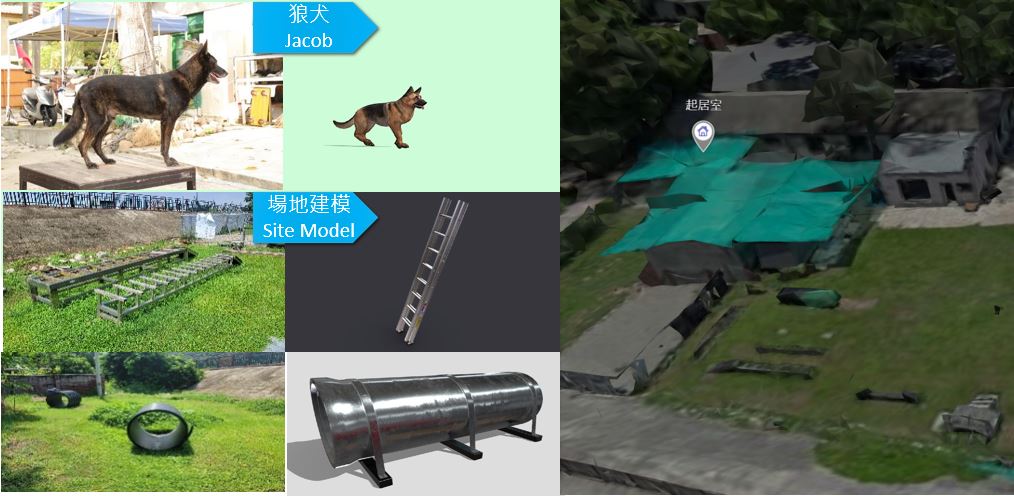
A digital model of search and rescue dogs, site, and training ground
As the industry develops, Less Code, No Code has gradually become a trend in the marketplace. Therefore, we will strive to develop a more user-friendly interface to help people without programming expertise to easily use the platform, and at the same time, programming professionals can also flexibly and highly efficiently use the shared tools provided by NCHC to optimize development efficiency. All this is to make the cloud-native geospatial information platform available around the life and work of people, and the quality of national policy implementation can be improved.
