 國家高速網路與計算中心
Cloud-Based Smart Point Cloud Processing (CSPCP) Construct Accurate Digital Models With Render Farm
CONTRIBUTING TEAM: Chia-Chen Kuo, Chih-Wei Wang, Yi-Lin Wu, Shu-Hsin Liu
Point cloud technology, used for generating digital models, is gradually assuming a pivotal role in the digital era. NCHC has developed an artificial intelligent point cloud technology, the Cloud-based Smart Point Cloud Processing (CSPCP), based on years of experience in graphic processing. This technology combines the Render Farm that provides an efficient and accurate digital model construction tool for domestic industry, academia, and research community.
The Point Cloud Technology refers to the use of scanners or other data-capturing devices to measure and collect points on the surface of objects. These points, with their position information in space, form a three-dimensional image. Due to technical limitations, the resulting point cloud scanning often results in distorted scans in both color and shape. To help improving the efficiency of calibration of the distorted scans, the AI point cloud technology of NCHC is introduced to replace the manual calibration. In addition, such technology also provides strong support for the last mile of 3D point cloud modeling.
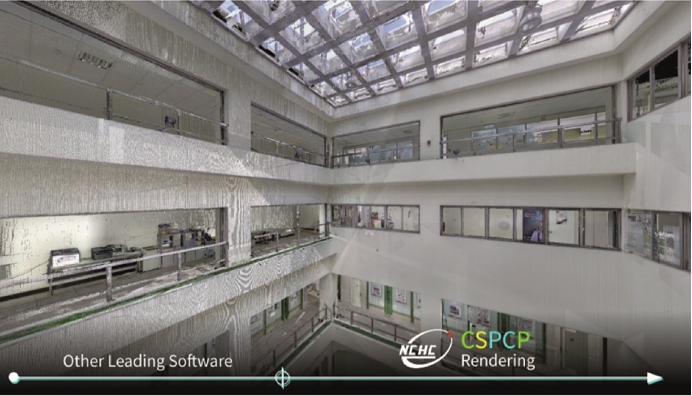
Before: there are abnormal lines and particles (left) ; After, CSPCP eliminates abnormal lines and particles (right)
For example, when scanning temples, the quantity of scanned point cloud data typically reaches the terabyte level, requiring about 6 months for manual inspection and correction. However, with the CSPCP’s AI automatic correction, the work can be done in just one month. The CSPCP not only automatically corrects abnormal colors and residual images in the 3D model of buildings or objects, but also achieves millimeter-level fineness and grain-free effects. The National Science and Technology Council has also utilized this technology to create the digital model of experimental fields for self-driving. It automatically reduces the noise of the point cloud file to less than 1%, and the remaining noise is handled manually. The whole process can be completed in one day which saves the processing time enormously.
The CSPCP performs better in terms of efficiency and convenience than the same type of technology developed by well-known foreign academic institutions. Tested by a public data set named Okland 3-D, the CSPCP accuracy rate is more than 95%, reaching the international pinnacle. The recognition rate is 100-600 times higher than that of the current first-class algorithm. In addition, it has also successfully applied for national patents, and users can use this technology through the NCHC Render Farm. In 2021, the CSPCP won the R&D 100 Awards, widely recognized as the “Oscars of Innovation,” and the Platinum Award in the 2023 Taiwan Innovation Expo Invention Competition.
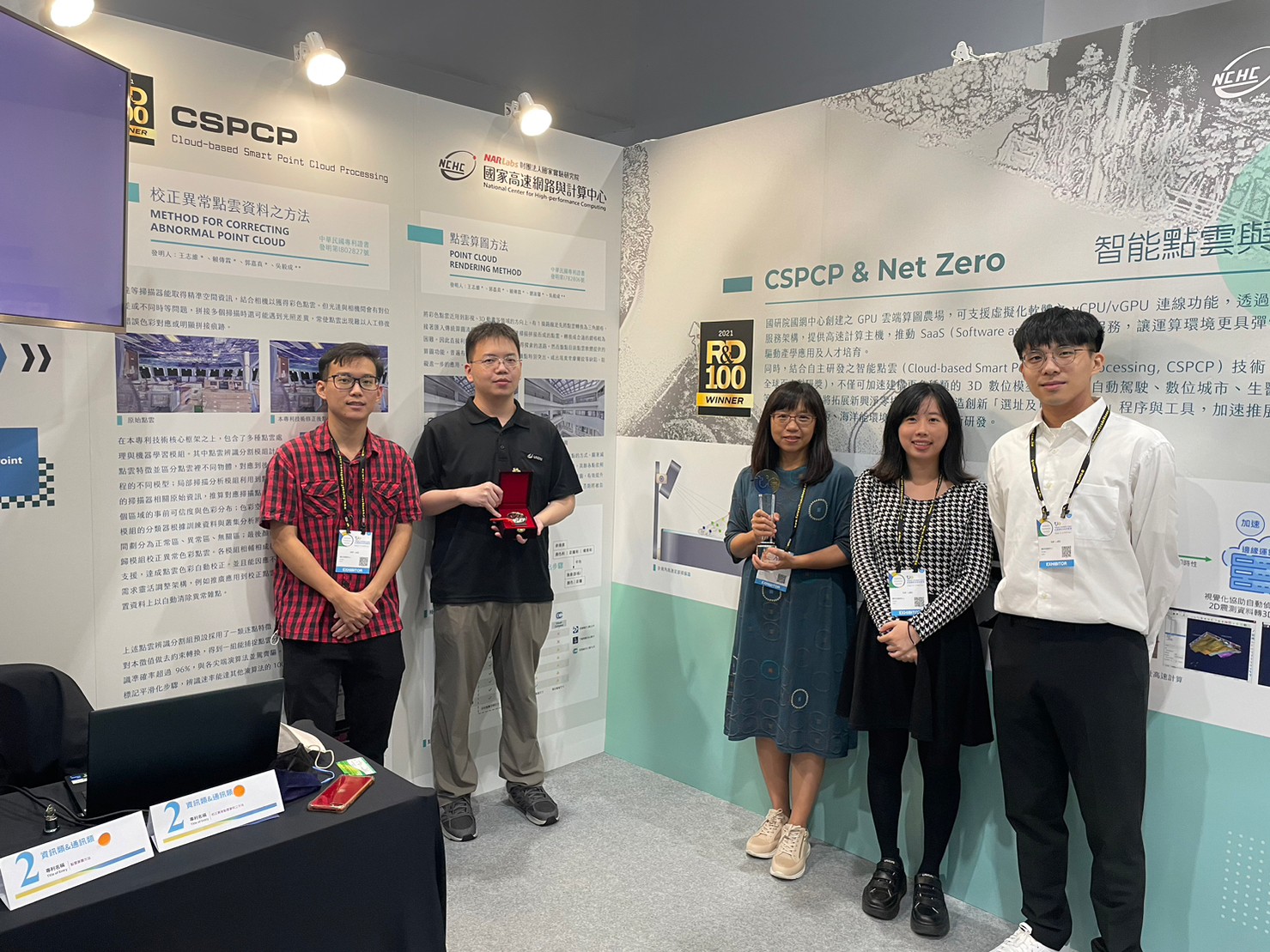
CSPCP was awarded the Platinum Award in the 2023 Taiwan Innovation Technology Expo Invention Competition
Combining the powerful performance and diverse applications of the CSPCP with the powerful engine of the Render Farm, is like putting the Heavenly Sword and the Dragon Slayer together–a perfect combination of tools and forces. The Render Farm, independently developed by NCHC, was opened to the public in 2011. This platform, with HPC as the core, integrates computer animation, special effect simulation, and calculation scheduling functions, which can solve the problem of excessive amounts of image data and affect work efficiency. Render Farm has been revised several times so far, and has successfully assisted the domestic film and television industry to optimize content and create innovative experiences. The well-known dancer Huang Yi’s dance performances, “Assassin Nie Yinniang,” “A Handful of Green,” “Scarlo,” and other films are successful productions under the support of the Render Farm.
With the powerful support of the Render Farm, the CSPCP will be able to provide higher quality and more efficient digital models for all users in Taiwan. Users can quickly utilize Render Farm from the cloud and process huge amounts of data, optimizing the efficiency of work remotely. Even with only 3G network, users still enjoy computing speeds of up to 60 frames per second. Therefore, even when the network environment is poor, as long as users connect to the Render Farm, they can quickly process the point cloud file and keep their work on schedule.
The CSPCP can find its way into diverse applications. In addition to the digital contents, a more representative application in the future is in the arena of carbon reduction. In recent years, the government has taken various measures toward the improvement of carbon reduction. Storing carbon dioxide underground or seabed are options of such measures. To sequester carbon dioxide under the seabed, the Taiwan Ocean Research Institute of NARLabs will explore suitable sites for carbon sequestration. Utilizing CSPCP, the sonar signals will be processed to generate 3D geological structure maps of the seabed, addressing the challenges raised by the unseen deep geological layers. And hopefully, the realization of the Net-Zero Carbon Emissions targeted in 2050 can be accelerated.
The establishment of digital models also brings new opportunities for the development of digital twins. In the future, the CSPCP will continue to play a key role in the application of digital twins through its efficient and accurate features, driving the continuous advancement of science and technology, and creating a more accurate and realistic digital world for us.
