 國家高速網路與計算中心
Smart City Applications: AI Models Make Urban Governance Smarter
CONTRIBUTING TEAM: Jyh-Horng Wu, Chung-I Huang, Chien-Hao Tseng, Jih-Sheng Chang
Leveraging years of expertise in image recognition, analysis technology, and urban information sharing, and integrating with deep learning technology, NCHC has developed two systems: the Traffic Congestion Prediction System (TCPS) and the Streetscape Recognition and Retrieval Platform (SRRP). TCPS and SRRP have been applied to Hsinchu City and Taichung City to mitigate urban traffic and to enhance public safety respectively with close collaboration between NCHC and the city governments.
Reducing traffic congestion has long been a priority for county and municipal governments' traffic policies. The common approach involves monitoring traffic flow at intersections with surveillance cameras and aggregating the data on a platform. While this platform offers real-time traffic flow insights, it primarily displays current road conditions without significantly improving traffic management. The TCPS goes a step further by providing crucial traffic metrics such as road occupancy, average speed, and traffic volume. It also forecasts road conditions up to 30 minutes in advance. This predictive capability enables city traffic management authorities to devise preemptive strategies to mitigate congestion.
The TCPS platform operates by collecting image data from existing surveillance cameras, employing deep learning algorithms and time series data technology for predictive analysis. Deep learning algorithms, with their self-learning capability, conduct an in-depth analysis of the movement direction of each vehicle captured in images. This allows for precise predictions of forthcoming traffic conditions using time series data technology. Currently, NCHC is in partnership with the Taichung City and the Hsinchu City to implement this system, and planning to extend collaboration to other cities.
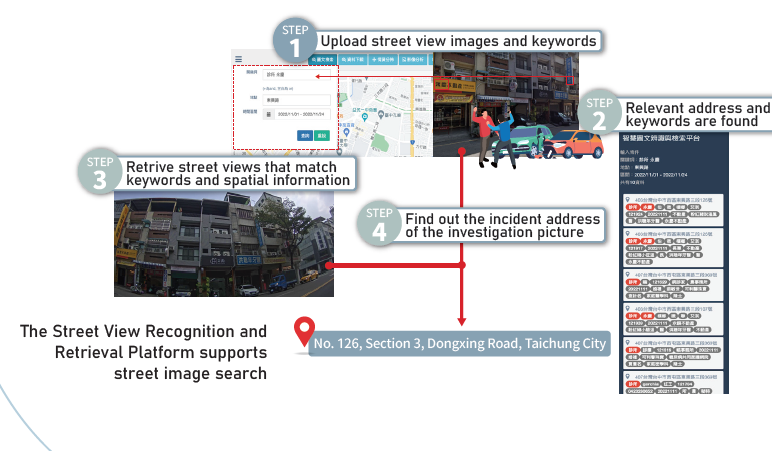
NCHC leverages image recognition in street view recognition and retrieval to enhance law enforcement through technology. This approach primarily focuses on analyzing the graphics and text on street view signboards. In instances where the police receive public reports or face emergencies, they can swiftly identify on-site signboards to accurately locate the incident, boosting the efficiency and precision of searches and investigations. While graphic recognition technology has been extensively utilized in commercial applications for years, the complexity of street view signboards presents unique challenges. Signboards often feature bilingual or multilingual texts, including Chinese, English, Japanese, Thai, and Indonesian, often accompanied by patterns and variations. This diversity and complexity make identifying street scenes more challenging.
To address this challenge, our team has been diligently expanding the sample database and fine-tuning the algorithm to enhance the system's recognition capabilities. This effort, in collaboration with the Taichung City and its Police Department, has led to the successful collection of over a million street view images, encompassing the entire Taichung City jurisdiction. This achievement lays a robust foundation for the system's future development. Looking ahead, the plan is to not only continue enriching the street view database but also to extend the system's application to other city governments, thereby amplifying their ability to enforce laws using advanced technology.
Over the years, NCHC has amassed considerable expertise and achieved significant milestones in multiple areas. This includes analyzing image data from selected regions in Taiwan, aiding the government in monitoring rivers and landslide conditions, and devising appropriate responses. NCHC has played a critical role in tracking road flooding, safeguarding citizens' lives and properties. Additionally, its technology has been adaptable for varied applications, such as verifying compliance with mask-wearing regulations and ensuring social distancing in public spaces during the COVID-19 pandemic. Looking forward, the concept of the Smart City will be a pivotal focus for NCHC. By leveraging existing security and surveillance video data, the Smart City initiative aims to enhance convenience for residents, improve government efficiency, and optimize the use of administrative resources.
We expect that the integration of image recognition with AI technology will be increasingly applied across various urban aspects, boosting the technological capabilities of domestic manufacturers through technology transfer. Simultaneously, we also look for international cooperation opportunities, exporting our technology abroad, and thereby enhancing the global application value of this technology.
