 國家高速網路與計算中心
The NCHC took part in the BIO Annual International Convention in Philadelphia and showed off its computational techniques in AI for medicine
2019.06.03
At the urging of the Ministry of Science and Technology, theNCHC represented the intelligent medicine teams of NARLabs on the Taiwan biomedical industries delegation to the BIO Annual International Convention. The delegation was led by Wu Zheng-zhong, minister without portfolio, the Executive Yuan. BIO International Convention was held in Philadelphia, Pennsylvania, the United States, from June 3 to June 6, 2019. The Taiwanese delegation--made up of 12 alliances, including GLORIA (Global Research and Industry Alliance)--put on 40 exhibition pieces on disease treatment, intelligent medicine, gene editing technologies, etc., spanning the spectrum of biomedicine and showing the prowess of leading-edge biomedical technologies in Taiwan.This was the second time that the NCHC and GLORIA have jointly participated in the BIO Annual International Convention. Representing the NARLabs, the NCHC showed in the Taiwan exhibit hall the state of research work that the NCHC was engaged in with the biotech industry. In addition to that, the NCHC also conducted on the spot scores of “discussions with partners” as well as working with Taiwanese firms to hold one-on-one discussions with foreign visitors to facilitate international exchanges and collaborations.
The scientific visualization team at the NCHC had developed the "Miil (Medical image illustrator) and marking tool", which was put on exhibit at the BIO Annual International Convention. The tool can, based on images, locate the organization or organ to be observed. Then the VVViewer (Visualization interactive media lab's VR Viewer) VR interactive viewing program converts 2D CT scans to 3D images that are colored and marked. With this technology, physicians can more quickly and more intuitively analyze the condition of the patient. This also allows the medical care team to make medical decisions in a shorter time.
In the past, doctors used 2D images to help them how the organs might look in 3D. Now, with the VVViewer, they can directly convert 2D images to 3D, which is presented with VR. All this improves the interactions between IT and medical workers. Furthermore, in the virtual 3D space, observations from many angles of the inside of human bodies can provide physicians with information about the heart, blood vessels, tumors, and abnormalities that is easier to grasp.
Under the leadership of GLORIA of the Ministry of Science and Technology, the Taiwanese delegation took part in the BIO Annual International Convention, a top-notch showroom for the best in international biomedicine, to flex Taiwan's biomedical might. The NCHC is honored to be a part of that delegation. It is hoped that, through this participation, the NCHC may receive big data from abroad to fortify Taiwan’s advantage in biomedical research. It is also hoped that, through this, we learn more about the developing trends in biomedical fields around the world. This knowledge can help us plan foundational information facilities at appropriate scales in order to support the biomedical industries in Taiwan.
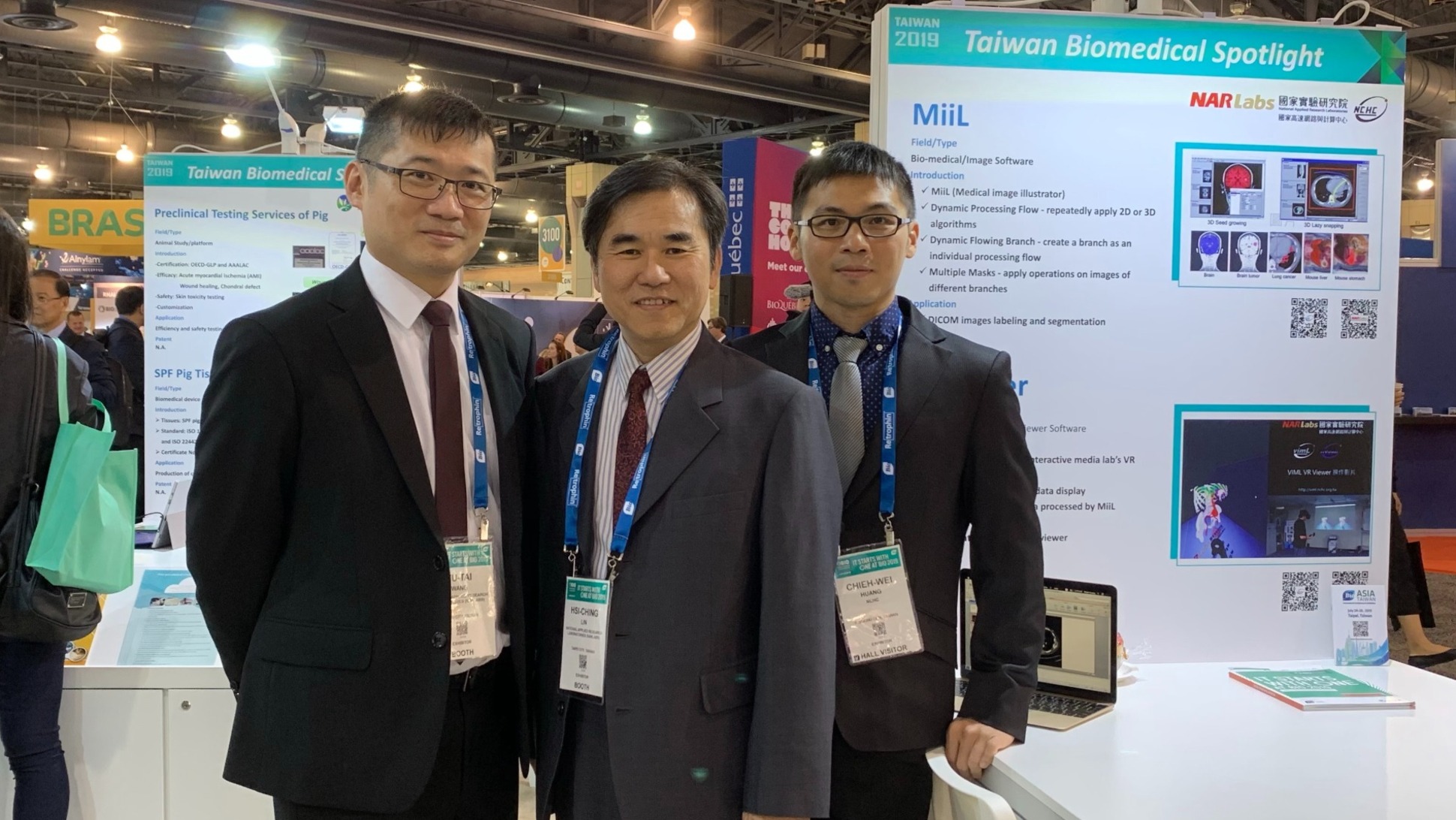
(from left) NCHC's Dr. Wang Yu-tai, Deputy Director General- Hsi Ching Lin, and assistant research fellow Huang Jie-wei in front of the NCHC booth at the Convention
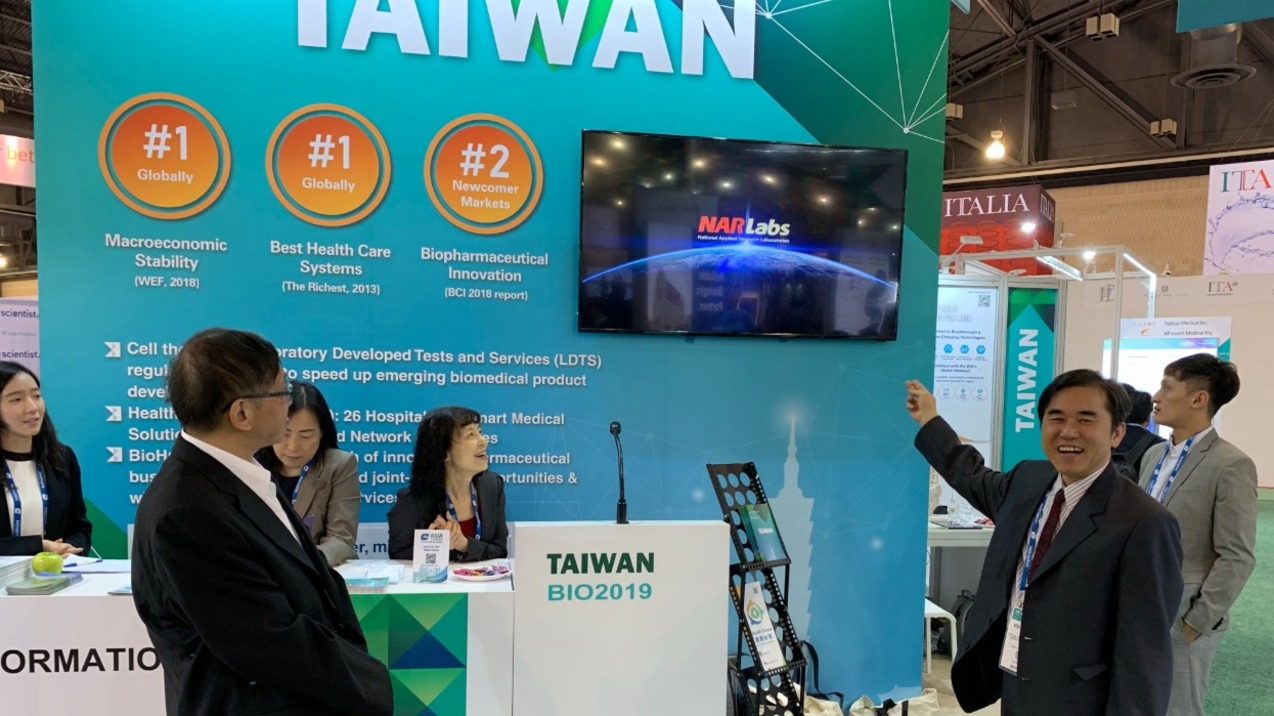
A film about the NARLabs is being played at the main booth of the Taiwan exhibit hall

NCHC associate research fellow Zhuang Chao-jun mans a booth at the BIO Annual International Convention
Note: GLORIA's participation in this international convention yielded a bumper crop. International businesses in Singapore, the United States, Canada, etc. signed collaboration agreements on the spot. For details, please refer to reporting in Commercial Times.