NCHC Drives Talent Cultivation as Taiwan Shines Globally: NTU Team Wins the Championship at the International Student Cluster Competition
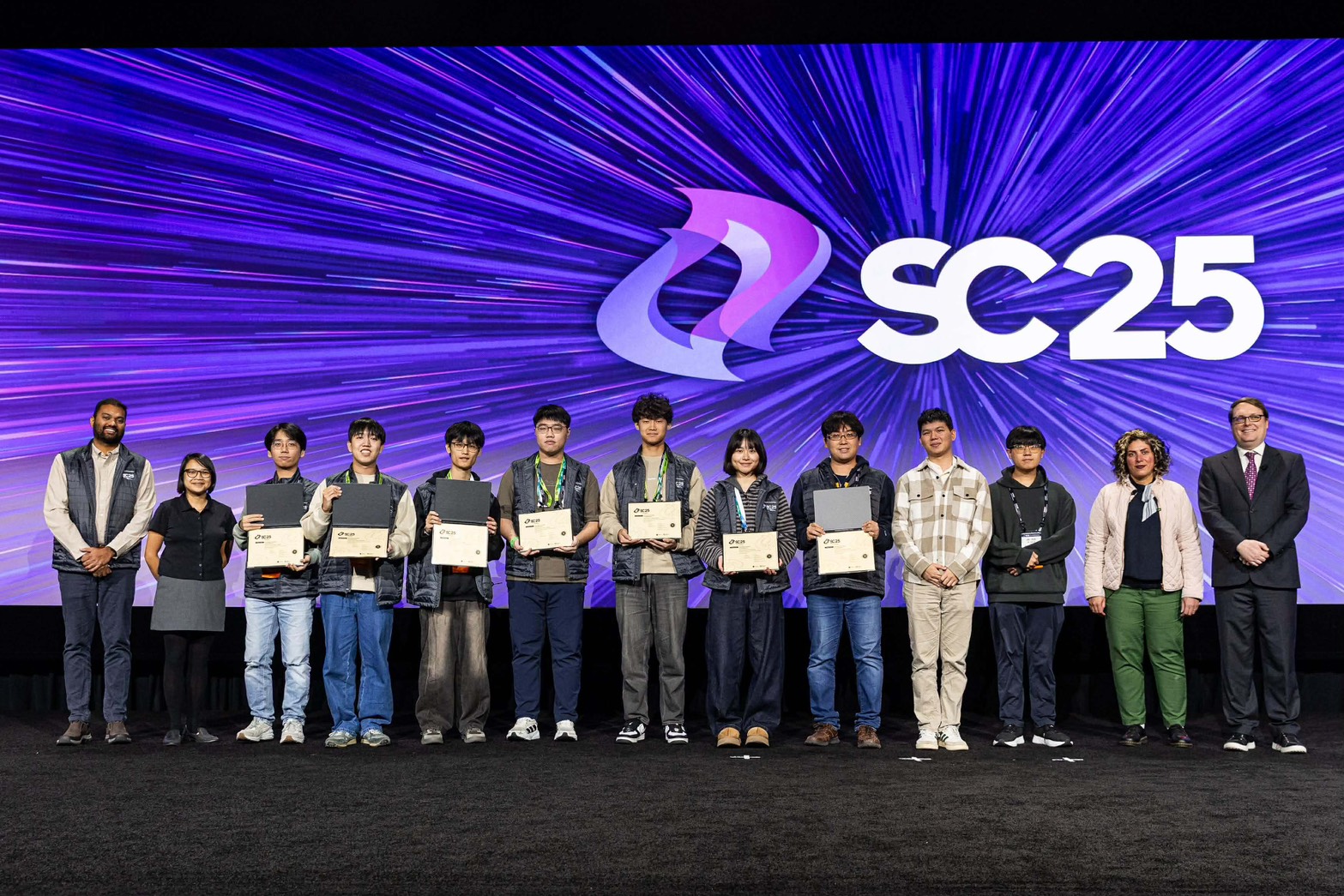
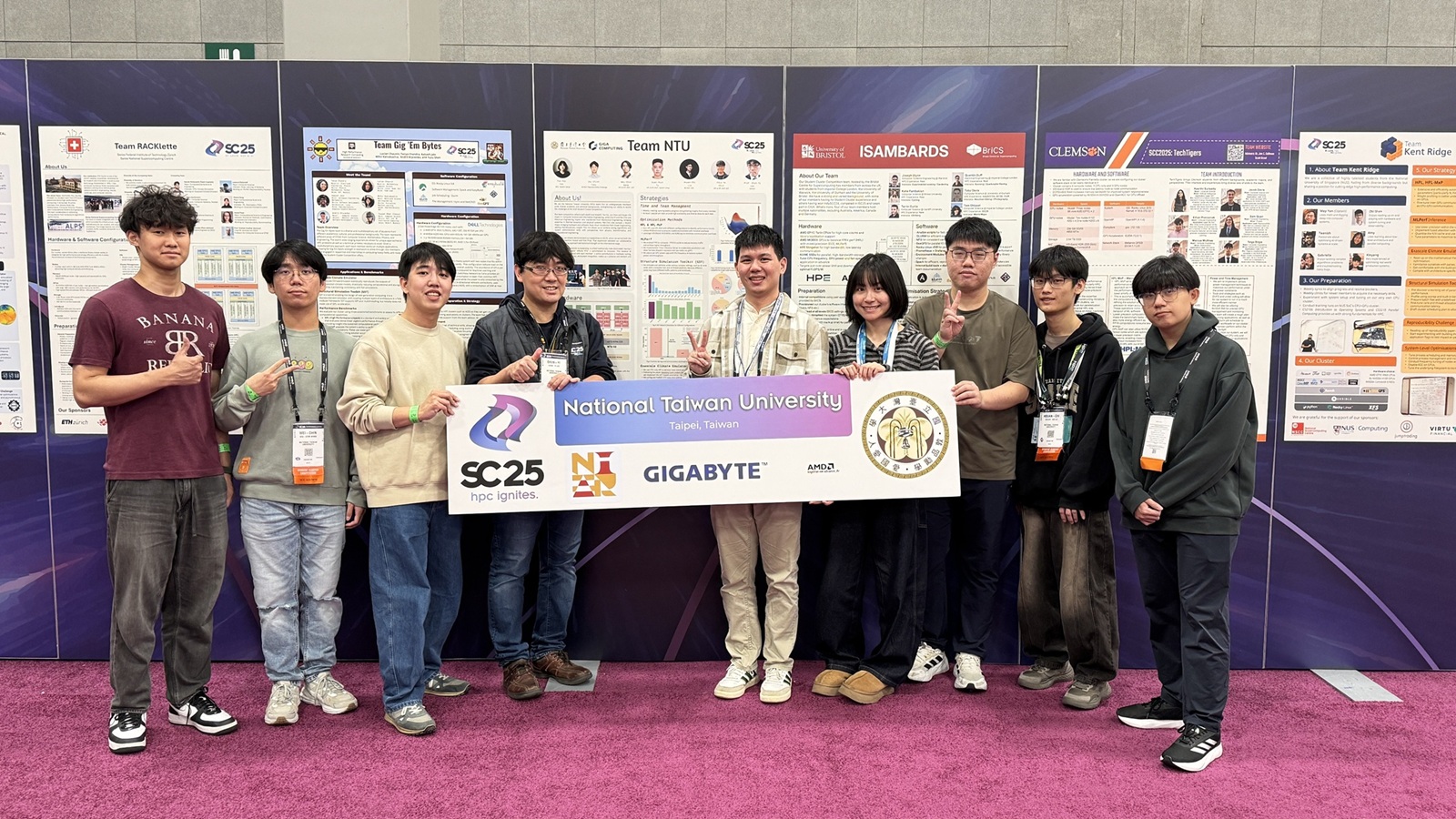
The representative team from National Taiwan University (NTU), with full support from the National Center for High-performance Computing (NCHC) of the National Institutes of Applied Research (NIAR), outshone other competitors in their debut appearance and won the championship in the world’s premier Student Cluster Competition (SCC) at the 2025 International Conference for High Performance Computing, Networking, Storage, and Analysis (SC25) held in St. Louis, U.S. The victory highlighted Taiwan’s strong competitiveness in high-performance computing (HPC) education and hands-on technical capability.
This year’s SCC featured eight top university teams from around the world, including ETH Zurich in Switzerland, the University of California San Diego, Nanyang Technological University in Singapore, and Texas A&M University in the United States. Most participating teams possessed years of competition experience and extensive hardware support. Although this was NTU’s first appearance in the SCC, the team demonstrated outstanding system configuration, application optimization, and teamwork. Despite the strict 10 kW power limit, they, outperforming all other competitors, ultimately clinched the championship.
NTU Team Demonstrates Comprehensive Hardware-Software Technical Capabilities
The SCC this year spanned both traditional high-performance computing and modern AI applications, covering a range of critical benchmarks and technical challenges. These included High Performance Linpack (HPL), which is the double-precision benchmark used for the global TOP500 supercomputer rankings, High Performance Linpack-Mixed Precision (HPL-MxP), which reflects the computational demands of contemporary AI workloads, and MLPerf, a benchmark widely used to evaluate machine learning system performance. The NTU team achieved the highest scores in both the HPL and MLPerf benchmarks, overtaking the second-place team by a wide margin. Their carefully engineered four-node cluster system featured GIGABYTE’s G494-ZB4 servers equipped with NVIDIA H200 NVL GPUs, AMD EPYC 9655C processors, Micron Technology’s high-performance memory, and Solidigm enterprise-grade SSDs. With its high-density, high-interconnect, and high-efficiency architecture, the system delivered top-tier performance across generative AI and HPC workloads, decisively surpassing all competing teams.
On the applications side, the competition focused on scientific simulation and system behavior modeling. This included the Exascale Climate Emulator, a climate simulation model recognized by the Gordon Bell Prize. This emulator was trained on more than 30 billion temperature data points. The task challenged participating teams’ combined abilities in parallel matrix processing and simulation accuracy. Another simulation tool, the Structural Simulation Toolkit (SST), did not rely on GPU acceleration, requiring participating teams to develop a deep understanding of system microarchitecture and hardware-software interactions. In addition, the competition featured a Reproducibility Challenge and a Mystery task. The NTU team excelled in all four application components, demonstrating outstanding systematic thinking and problem-solving skills. While many participating teams failed to complete all tasks due to time and resource constraints, the NTU team managed to balance application scheduling optimization, system stability, and debugging proficiency within the strict power limit. Even under great stress, they still showcased exceptional skill in coordinating hardware-software optimizations, fully demonstrating their comprehensive technical capabilities and adaptability to different situations.
Industry-University Collaboration Helps Taiwanese Students Shine on the Global Stage
Chun-Yi Lee, Professor of NTU’s Department of Computer Science and Information Engineering who led and advised the team, said, “This trophy is not just for NTU. It represents the collective achievement of Taiwan’s entire high-performance computing education community.” He added,
“Supercomputing technologies have exceptionally broad applications, ranging from AI and quantum computing to scientific simulations. High-performance computing capability has become a key indicator of national competitiveness. Since Taiwan’s talent cultivation and resource investment in this field remain relatively limited, this victory will inspire more Taiwanese students to pursue high-performance computing and bring new momentum to Taiwan’s technological development.”
Professor Lee emphasized, “Winning the championship would not have been possible without the long-standing support and cultivation from NCHC. From arranging training programs to helping us secure hands-on equipment and computing resources, NCHC has been the strongest pillar backing us up. We are also deeply grateful to GIGABYTE, AMD, and NVIDIA, our industry partners, for providing state-of-the-art hardware, technical guidance, and personnel support, as well as to NTU’s College of Electrical Engineering and Computer Science, the Department of Computer Science and Information Engineering, and the Department of Electrical Engineering for sponsoring airline tickets and related expenses.” This marked NTU’s first participation in an international-level student cluster competition. Most team members were selected from students who completed last year’s parallel programming course. Although they lacked practical competition experience, their enthusiasm and eagerness to learn enabled them to seize this rare opportunity to compete on a global stage.
HiPAC Experience Lays a Solid Foundation
NIAR has long been committed to cultivating scientific and technological talent in Taiwan. Aside from winter and summer camps, this is advanced via NCHC’s “High Performance Application Competition (HiPAC),” a student competition focused on hands-on supercomputing operations. Through these initiatives, students gradually develop core competencies in system configuration, software performance tuning, and application acceleration, thereby fostering a new generation of talent in HPC and AI. The NTU team also gained valuable experience by participating as an observer team in the HiPAC, which laid a solid foundation for their subsequent success in the international competition.
Looking ahead, NCHC will continue to expand its collaboration with the industry and academia. By integrating educational resources and strengthening international partnerships, it aims to cultivate more world-class talent in the field of high-performance computing, enhance Taiwan’s overall technological competitiveness, and ensure that Taiwan continues to shine on the global stage of technological innovation.