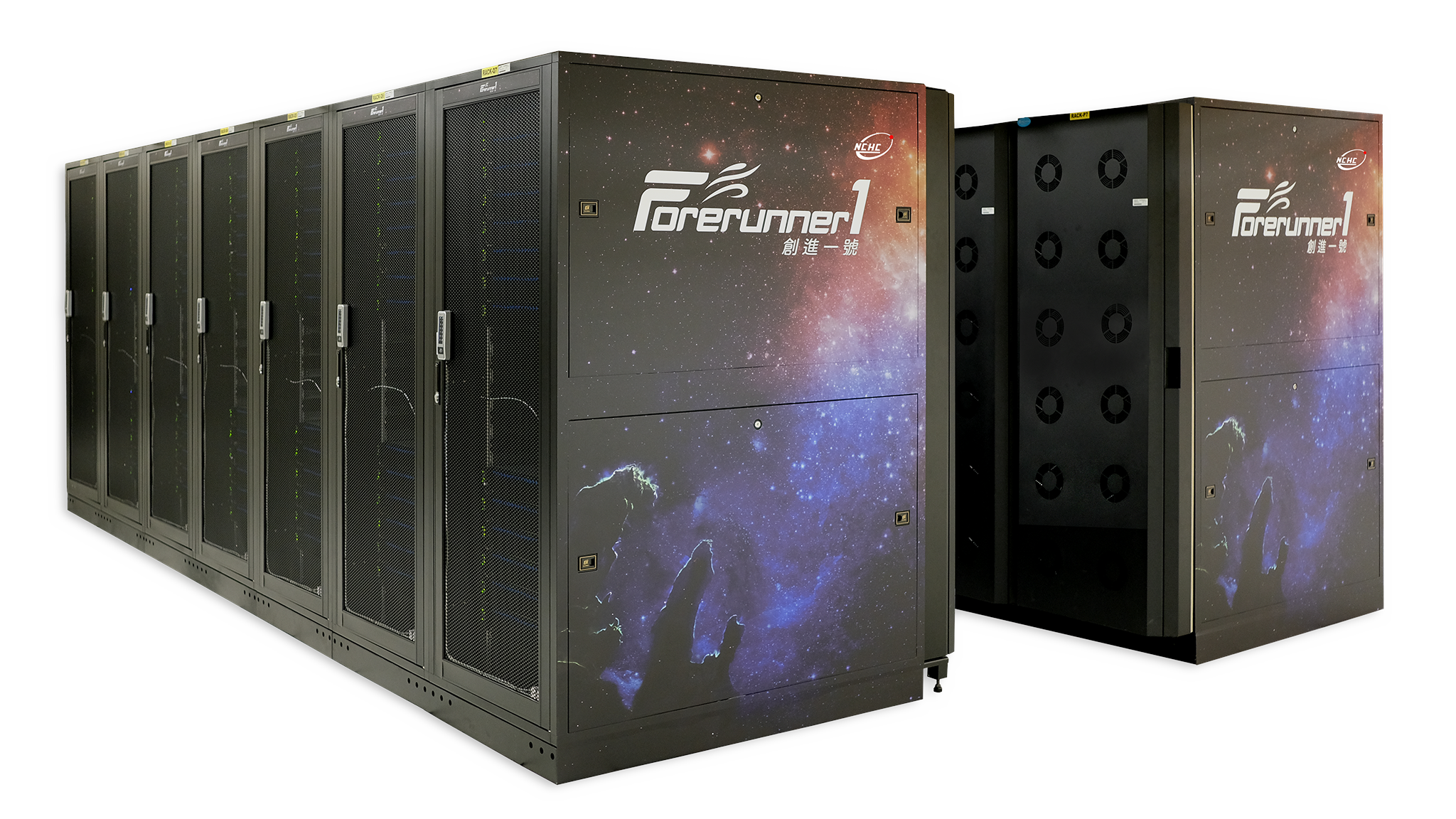
Promoting Digital Transformation and Technology Innovation: Super Computer Forerunner 1 Activated
The latest supercomputer “Forerunner 1,” built by the National Center for High-performance Computing (NCHC) under the National Applied Research Laboratories (NARLabs) and the National Science and Technology Council (NSTC), was activated in July 2024, providing computing services in place of the decommissioned “Taiwania 1.” The installation of “Forerunner 1” began in 2023 at NCHC’s Tainan Branch, with the objective of providing academia with high-performance computing resources.
High-performance computing is the cornerstone of scientific research and development. NCHC, Taiwan’s only national laboratory that provides high-performance computing services needed for interdisciplinary scientific R&D, is equipped with a world-class computing mainframe, an advanced data storage environment, a wide range of software, and databases. The center aims to promote academic output in various fields and make contributions to society.
“Forerunner 1” is built with a CPU architecture. It includes 558 compute nodes based on the x86-64 architecture, with a total of 62,496 computing cores. Its computing performance can reach up to 3.5 petaflops, with a storage capacity of 9.2 PB. Additionally, it is equipped with 40 compute nodes based on the ARM architecture, allowing users to conduct preliminary heterogeneous architecture tests. These tests serve as a reference for the future construction of new mainframes at NCHC. “Forerunner 1” uses the same SLURM scheduling system and high-performance InfiniBand networking as “Taiwania 3,” ensuring enhanced performance, scalability, and reliability. Users don’t need to relearn job script syntax, and most source codes can be used with only minor adjustments and recompilation.
NCHC builds supercomputers with different architectures to address large-scale scientific and artificial intelligence (AI) challenges. The CPU-architectured “Forerunner 1” is suitable for various high-performance computing tasks, including weather forecasting, astrophysics simulations, molecular modeling, engineering design, and simulation. This supercomputer provides essential computing resources to support these specialized fields.
NCHC Director-General Chau-Lyan Chang stated, “With better energy efficiency that enhances computing performance, ‘Forerunner 1’ replaces ‘Taiwania 1,’ a supercomputer built in 2017 with an efficiency of only 1.7 petaflops. As high-performance computing and AI rapidly develop globally, computing power is directly linked to a country's technological competitiveness. NCHC will gradually establish a stronger computing infrastructure. By the end of this year, we will complete the construction of a 16-petaflop GPU capability to meet the research and application needs of large language models (LLM) and data-driven AI. Following the trends in high-performance computing development in advanced countries, our goal is to complete the construction of a 200-300 petaflop computing power system by 2028, further enhancing Taiwan's competitiveness in global technology R&D.”
During the preliminary testing, “Forerunner 1” showcased excellent performance in many fields such as astrophysics, fluid mechanics, atmospheric sciences, high energy physics, and computational materials science. Leveraging the power of “Forerunner 1”, astrophysicist in Academia Sinica were able to accelerate their computations by a factor of five compared to using their laboratory workstation. National Chung Hsing University and National Cheng Kung University substantially increased the scale of fluid mechanics simulations, reducing the computing time for billion-level workload from several months to 40 hours. In certain cases of National Taiwan University’s ocean-atmosphere coupled model tests showed an 80% improvement in efficiency compared to “Taiwania 3.” Additionally, research in quantum chemistry and computational materials science significantly accelerated, demonstrating that “Forerunner 1” is a strong driving force for scientific innovation.
With the activation of “Forerunner 1,” NCHC will continue to promote the development of high-performance computing technology, provide logistical support for Taiwan’s technological innovation, and aid in advancing digital transformation. This will help Taiwan maintain its status as a leader in global technological competition and create more possibilities.